


OpenAI Shuts Down Two Covert Influence Operations Linked to Russia and Iran
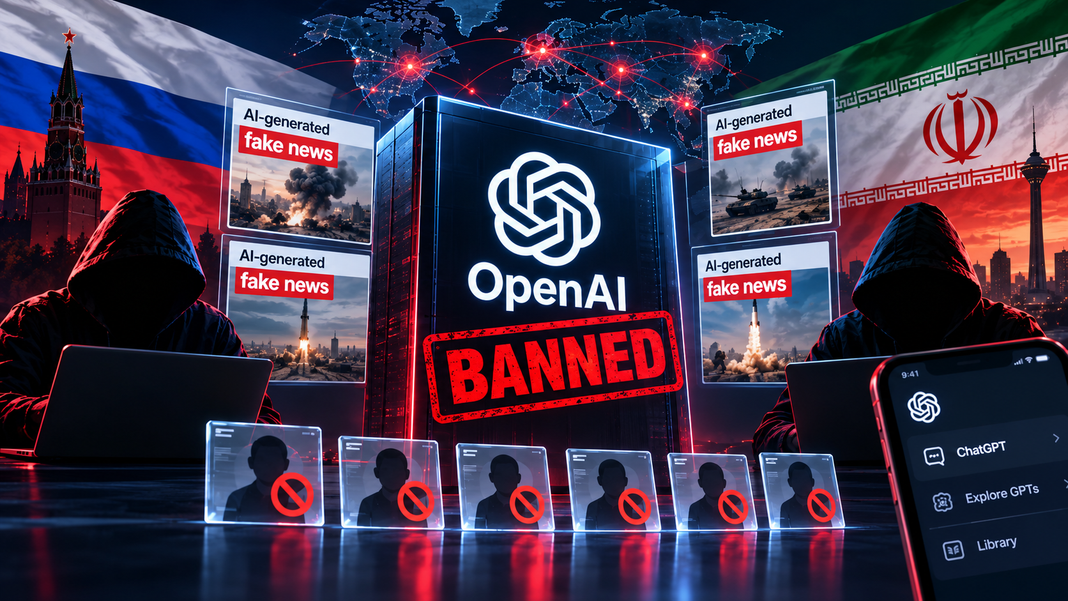
OpenAI bans accounts linked to Russian and Iranian influence operations that used ChatGPT to create political content, build fake identities and spread misleading narratives online. The company announced the takedowns on October 8, 2026, and said it passed its findings to the relevant authorities.
According to OpenAI, the groups combined AI-generated material with traditional influence tactics to make their campaigns look legitimate. The Russian operation targeted audiences across Latin America, while the Iranian campaign used fabricated journalist identities to place articles in established online publications.
(Add the Rank Math Table of Contents block here)
Why OpenAI Bans Accounts Linked to Russia and Iran
OpenAI calls the campaigns “false front” operations because the people and organisations delivering the messages appeared independent of the actors behind them. Instead of relying only on fake social media profiles, the operators used ChatGPT alongside websites, fabricated personas and editorial pitches. Their goal was to place geopolitical messaging in front of audiences through channels that looked credible.
When OpenAI bans accounts like these, it targets clusters of users working together rather than single profiles. The two operations differed in method and focus.
| Operation | Origin | Main Tactic | Primary Focus |
|---|---|---|---|
| Dark Clark | Russia | A purported research organisation publishing reports and influence material | Latin America, Ukraine, local politics |
| Bogus Bylines | Iran | Fake journalist identities pitching articles to online publications | US-Iran relations and the wider conflict |
Operation Dark Clark: A Russian-Linked Fake Think Tank
The Russian-linked campaign used ChatGPT to support activity aimed at audiences in Latin America. At its centre was a purported research platform called the Social Research Center (SRC). It presented itself as an independent research initiative, but OpenAI says it was part of a wider influence operation.
OpenAI bans accounts tied to Dark Clark after finding they were drafting reports for the fake Social Research Center. Much of the content appeared designed to damage Ukraine’s reputation in the region. Some of it also seemed aimed at influencing political outcomes in Argentina and Bolivia.
How ChatGPT Was Used in the Russian Campaign
OpenAI identified three main uses:
- Internal reporting: writing reports about the operation’s activities and the people involved
- Content creation: producing material to support the campaign’s messaging
- Platform reporting: drafting performance reports for the purported research centre
OpenAI also noted that some people in Latin America linked to the project may not have known Russian operators were behind it.
The company rated Dark Clark Category 5 on its six-level Breakout Scale. It is the first operation OpenAI has disrupted at that level. The rating reflects OpenAI’s own assessment of the campaign’s characteristics and apparent impact, not a universal measure of Russian disinformation.
Operation Bogus Bylines: Iran’s Fake Journalists
The second campaign, traced to Iran, used ChatGPT to draft and refine long-form articles, editorial pitches, social media comments and internal reports. In this case, OpenAI bans accounts that used seven fabricated journalist personas to pitch articles.
Key findings:
- Seven fabricated journalist personas were presented as writers from Western countries.
- Nearly 100 articles appeared under the fake bylines across more than a dozen online outlets worldwide.
- Content was produced in Persian and English.
- Operators used VPNs to hide their location when accessing ChatGPT.
- Many articles focused on the US-Iran conflict and criticised US actions.
OpenAI rated this operation Category 4 on the Breakout Scale.
Why Placement in Real Outlets Matters
An article on an established website carries more credibility than one on a newly created propaganda site. Once published, it can be shared on social media, cited by other websites and read by people with no reason to doubt the author’s identity.
OpenAI said at least some of the articles were promoted through the social media accounts of the outlets that published them, which extended their reach. The company also assessed that campaigns placing narratives in established media appeared to reach wider audiences than those relying mainly on fake social media accounts.
The findings do not show that the publications knowingly took part. In most cases, the deception lay in the identities and affiliations of the people pitching the material.
How AI Helped the Operators
AI did not run these campaigns alone, but it made parts of the work faster and cheaper.
| AI-Supported Task | Advantage for Operators |
|---|---|
| Drafting articles | Faster long-form production |
| Editing and translation | Messages adapted for different languages and audiences |
| Editorial pitches | Customised proposals for individual publications |
| Social media comments | Many variations of similar messages |
| Internal reporting | Easier tracking and summarising of results |
| Persona development | Content published under fabricated identities |
Translation, editing and drafting are legitimate uses of AI. The problem arises when they support deception, impersonation or covert manipulation.
Limits of the Findings
These findings come from OpenAI’s own threat-intelligence investigation, so a few cautions apply:
- Attribution of covert campaigns is difficult. OpenAI described the operations as originating in Russia and Iran, not as proof that every participant acted on direct government orders.
- Reach does not prove that readers believed the content or changed their views.
- Not every AI-generated article is misinformation.
Even when OpenAI bans accounts, operators can open new ones or switch to other AI tools.
How OpenAI Bans Accounts and Fights AI Misuse
OpenAI banned the account clusters linked to both operations and shared relevant information with authorities. It also publishes regular threat-intelligence reports to help policymakers, researchers and technology companies understand how malicious actors misuse AI.
However, bans alone are not enough. Spotting coordinated activity also means looking beyond AI platforms, at websites, social media profiles, publishing histories and account relationships. Readers interested in related topics can explore our posts on AI safety and ChatGPT news.
What Newsrooms and Readers Should Take Away
For publishers, these cases are a reminder to verify author identities, check sources, confirm claims and scrutinise unsolicited pitches. A polished article is not necessarily an accurate one, and fluent writing says nothing about who the author really is.
Readers should also check who is behind a story, not just what it says. For more on spotting false content, see our guide on how to identify fake news.
What Happens After OpenAI Bans Accounts
OpenAI is expected to keep investigating coordinated misuse as influence operators adapt. Open questions include whether bans disrupt campaigns for long, whether the same actors move to other tools, and how far their content spreads after publication. Media organisations will need stronger verification without treating all AI-assisted writing as suspect.
In the longer term, digital provenance, transparent authorship and better verification of political content will matter more. AI can make convincing articles easy to produce, but it cannot confirm that the claims in them are true.
Bans are only one step, but the way OpenAI bans accounts shows that AI companies are now actively hunting for coordinated misuse. Effective responses will need cooperation among AI developers, publishers, researchers and authorities, alongside careful protection of legitimate political expression.